

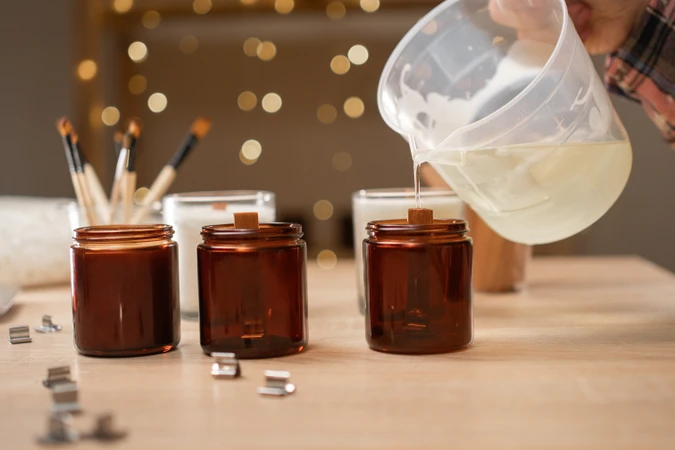
If you make candles, sauces, syrups, gift sets, or anything else that sells in bursts, you know what time of year it is! Q4 is when demand starts to spike for holiday-related gift items. Are you ready for the surge of business? Now is the time to see how well you’ve planned your inventory for your peak season.
Production is usually not what trips up seasonal brands, but packaging often can be. A product can't ship without its bottle, jar, closure, and box, and each of those has its own lead time. Here's how to plan around peak demand without tying up too much cash or running short at the worst moment.
Start With Lead Times
Many seasonal planning mistakes start with counting backward from the wrong date. Work backward from the day you need filled product, and add up every step in between:
- Supplier lead time: This is how long it takes the packaging to ship once you order, including any backorder risk on popular items. At Burch, we share our order processing time for in-stock items in the banner at the top of our website. Add our processing time to the number of shipping days you’ll need for your order to arrive to your address.
- Receiving and QC: Make sure to budget a few days to inspect, count, and store your orders once they arrive.
- Decoration or labeling: Next, remember to add up how much time printing, labelling, and assembling will realistically take.
- Production and fill time: Consider your own capacity, especially if you're making thousands of units in a short window. What hours will you work and how many units do you anticipate making each day?
- Fulfillment buffer: Your customers also need time to purchase and receive your items before the target date, especially for online businesses that ship. Add a buffer, including time to pack and ship, plus carrier slowdowns in peak weeks.
Stock items usually ship faster than custom or decorated ones, but even regularly-stocked items can sell out when everyone is ordering for the same season. Have questions about how much stock we have of one of your popular packaging items here at Burch? Give us a call and chat with us about what and when you’re expecting to order so we can help advise you on this process!
Once you’re got the whole timeline, add all the weeks together and then add a cushion. For instance, if your total comes to six weeks, plan for closer to eight.
When to Place Your Q4 Orders
For holiday products, the safest approach is often to treat Q4 as a summer project. Many brands start to think about holiday packaging too late in the year, which is exactly when suppliers get busiest and popular sizes get scarce.
A workable timeline may look like this for your business, if the holidays are your peak season:
- Spring: Review last year's sales by SKU and month. Decide which products are returning, which will be new, and which are being retired.
- Early Summer: Finalize your forecast and lock in packaging specs. Request quotes for anything decorated or custom.
- Late Summer: Place orders for custom or decorated packaging, and for any items you'll need in large quantities.
- Early Fall: Place orders for standard stock items, and confirm delivery dates.
- Late Fall: Fill and build inventory. This is also the time to place a small top-up order for anything trending ahead of your forecast.
If you're reading this in the thick of the season and haven't ordered yet, don't panic! Check what's available in stock now, prioritize your best-selling SKUs, and consider simplifying your lineup. It's better to ship three products on time than six products late. Also give us a call! Burch is happy to advise you on another jar or bottle that may suit your needs if something you are looking for is currently out of stock.

Calculating Safety Stock
Safety stock is the extra packaging you hold to cover surprises, such as a faster-than-expected sales spike, a delayed shipment, or a damaged pallet. You don't need an advanced model to get a useful number. Try using this to calculate your safety stock:
Safety stock = (Maximum daily usage × Maximum lead time) − (Average daily usage × Average lead time)
For instance, say you normally use 100 glass straight sided jars a day during peak season, but your best week hit 150 a day. Burch usually delivers to your location in 10 days, but you've seen it take 14 days.
- Max: 150 × 14 = 2,100
- Average: 100 × 10 = 1,000
- Safety stock: 1,100 jars
This cushion can help protect you from unexpected changes that can happen during your peak season.
Consider these few tips for applying this safety stock principal:
- Calculate per SKU, not across your whole catalog. Your hero product needs a bigger buffer than something more niche.
- Remember all components. A jar without its lid is just a jar. Safety stock applies to closures, labels, inserts, and shipping cartons, too.
- Round up to case or pallet quantities. Ordering in full cases and pallets is usually more cost-efficient and simplifies counting.
- Use real data. If this is your first season, stay on the conservative side and then make note of your actual usage so next year's math is even more accurate.
How to Use Limited-Edition Packaging Without Creating Dead Stock
Limited-edition packaging is one of the easiest ways to make a seasonal product feel special. It's also an easy way to end up with a closet full of unsellable containers after the holidays, however. The goal is to create the feeling of limited without the risk of obsoletion with how you manage your stock.
Consider keeping the base neutral and change the layer on top. Use your standard glass bottle or jar and make the seasonal element something smaller and simpler to replace: a label, a ribbon, a sleeve, a gift box, a closure color, etc. If the seasonal layer doesn't sell through, your core product can still work year-round.
Choosing timeless over trendy options also can extend the life of your product edition. An antique green, a warm amber, or a classic clear glass reads as "holiday" in December and as "premium" in April. A very specific theme, like a particular year or character, can be a bit harder to pivot from later.
When ordering for limited runs, try to base your numbers off of your confident forecast, not your hopeful one. Plan to sell out of your stock and make scarcity a part of the appeal. You can always add a waitlist for next year!
If you do happen to have leftovers, have a plan in mind, like a January promotion, a bundle with a core product, wholesale or corporate gifting, or a repurposed "everyday" label.

Tie Your Packaging Plan to Your Promotional Calendar
Your inventory plan and your marketing plan could even be the same document! Map out when your seasonal products launch, when your email campaigns and ads run, and when key shopping dates fall. Make sure to check that your packaging supply can support each stage of the calendar.
At the end of the season, take a look back and adjust the calendar for next year. The best seasonal planning gets easier every year. After each peak, take some time to record what sold, what didn't, and the SKU. Make note of your actual lead times versus what you may have guessed or were quoted.
Keep everything in something as simple as a spreadsheet. By next year, you'll have your own data and your safety stock numbers will get even more accurate.
Whether you’re mapping out next season's packaging needs or in the thick of this season right now, there are steps you can take to have a successful holiday season! For help choosing bottles, jars, or closures that scale well across all seasons, the Burch team is here to help. Give us a call or reach us through our website today.